
By Frank Kettey
In Ghana’s cities, millions still struggle to access safe, reliable water. For too long, efforts to improve services focused on short-term fixes: a tap here, a standpipe there. But anyone who has worked in urban water knows the truth: infrastructure alone cannot solve the problem. Sustainable change comes from systems, well-managed utilities, accountable municipalities, and policies that put people first.
At WSUP Ghana, we have spent the last decade proving this approach works. What began as community-based interventions in low-income settlements has evolved into institutional transformation. Today, we work alongside Ghana Water Limited, the Community Water and Sanitation Agency, and more than 30 municipalities to deliver financially viable and scalable water services. More than 14 million people are already benefiting.
Our work is practical and measurable. In Ashanti and Western regions, we have helped utilities reduce water losses, improve billing and collection, enhance water quality, and deploy energy-efficient solutions. Utility staff are trained to manage systems professionally, not just keep pumps running. In the Ashanti region alone, we have expanded networks, installed water storage and treatment facilities, and deployed solar-powered systems, bringing safe water to households that had none.
But water is about more than taps. It is health, education, and equality. Through our partnership with the School Health Education Programme, we have upgraded 40 schools with disability-accessible toilets, mechanised boreholes, and rainwater-harvesting systems, benefiting over 20,000 students and teachers. Hygiene education, menstrual health management, and school health committees ensure these facilities make a real difference.
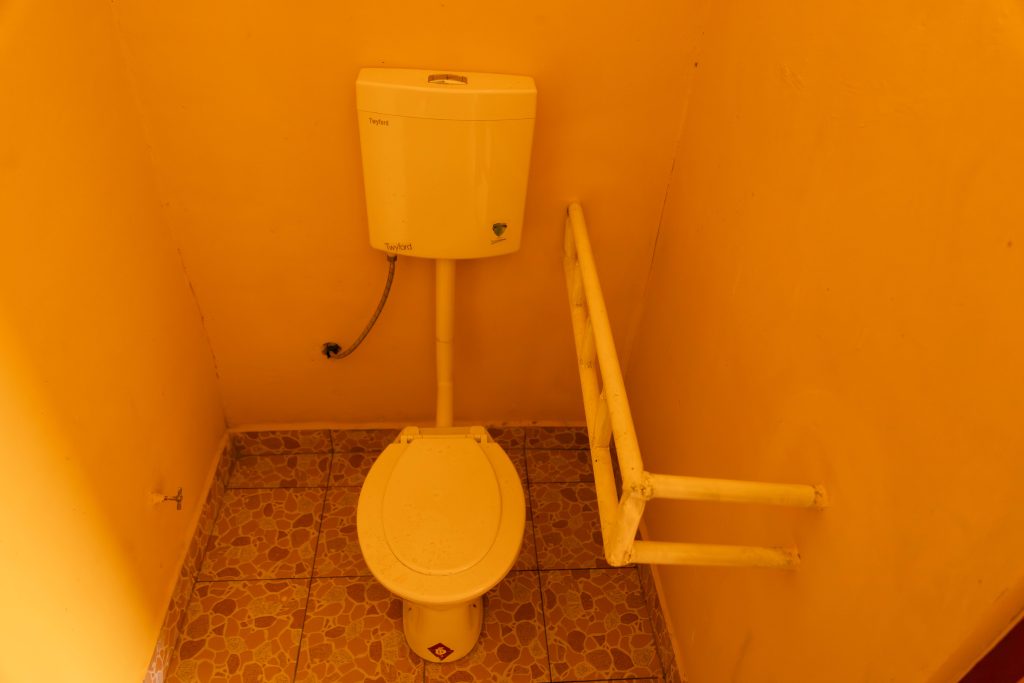
A newly constructed toilet for school-going children
We are also committed to changing who holds the levers of power. By mentoring female staff in technical and managerial roles, we are building leadership where it counts, so that women are shaping the future of water in Ghana.
Digital innovation is another game-changer. Our use of platforms like mWater to map and monitor assets means utilities can spot problems before they become crises. Schools and municipalities now have real-time data to improve planning and accountability. These are not pilots; they are building the backbone of a national water management system.
The lesson is simple: safe, reliable urban water is less about pipes and more about systems. Infrastructure without governance, capacity, or accountability is temporary; systems change lasts.
Ghana stands at a pivotal moment. Frameworks are in place, financing is starting to flow, and tested models exist. Now we need to scale, de-risk co-financing, and ensure low-income residents remain central to service expansion. WSUP Ghana’s work shows it can be done, but only if we think beyond taps and toilets and focus on the institutions that make water work for everyone.
Because in cities across Africa, the next water crisis is never just about scarcity. It is about governance, management, and the systems that decide who gets water and who does not. That is where the future of urban WASH lies, and that is where WSUP Ghana is leading the way.
Frank Kettey is the Country Manager for Water and Sanitation for Urban Populations in Ghana.