

Across many rapidly growing cities, access to safe sanitation remains a major challenge. Population growth, climate-related shocks and years of underinvestment in infrastructure have left millions of people without reliable sanitation services, particularly in low-income urban communities.
Traditional sewerage systems can help address these challenges, but they are often expensive to build and difficult to extend into densely populated informal settlements. As cities search for practical and affordable solutions, simplified sewer systems are emerging as an effective alternative.
What are simplified sewer systems?
Simplified sewer systems (SSS) are low-cost sewer networks designed specifically for dense urban areas. They operate on the same principles as conventional sewerage systems but use smaller pipes, shallower trenches and more flexible layouts that can follow existing footpaths and settlement patterns.
Because they require less excavation and construction, simplified sewer systems can cost 30–50% less than conventional sewerage, depending on the local context. This makes them particularly suitable for expanding sanitation services to underserved communities where traditional infrastructure may be financially out of reach.
Why do they matter?
Safe sanitation is about more than toilets. Without a system to safely transport and treat wastewater, communities remain vulnerable to disease outbreaks, environmental contamination and the impacts of flooding.
Simplified sewer systems help address these challenges by:
- Providing affordable access to safe sanitation for low-income households.
- Reducing the risk of faecal contamination during floods and extreme weather events.
- Safely conveying wastewater away from homes and waterways.
- Supporting more inclusive urban development by extending services to informal settlements.
- Making better use of existing trunk sewers and treatment plants that may otherwise remain underutilised.
As cities across Africa and beyond work towards Sustainable Development Goal 6 and Citywide Inclusive Sanitation (CWIS), simplified sewer systems offer a practical pathway to expanding services while building climate resilience.
Delivering impact in Kenya
Working in partnership with local utilities, WSUP has supported the design and construction of simplified sewer systems in low-income communities in Nairobi, Nakuru and Naivasha. The projects have delivered more than 10 kilometres of sewer infrastructure, connected and upgraded hundreds of sanitation facilities, and improved access to safe sanitation for more than 18,000 people.
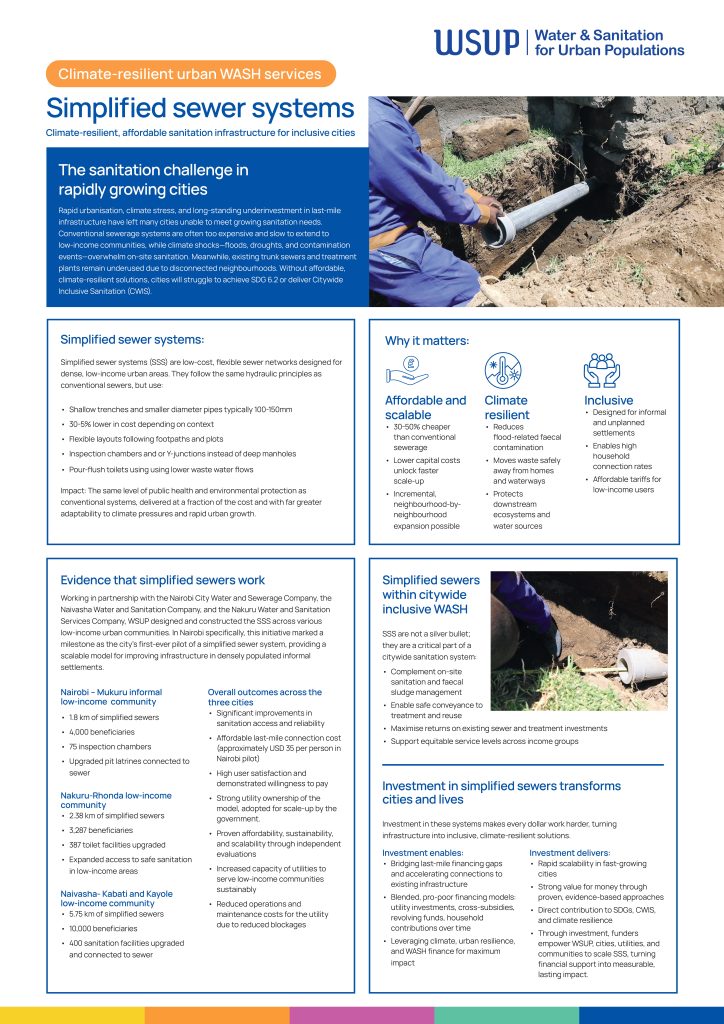
The results have been encouraging. Independent evaluations have demonstrated strong affordability, sustainability and scalability, while communities report high levels of satisfaction and willingness to pay for improved services. Utilities have also benefited through reduced maintenance costs and increased capacity to serve low-income areas sustainably.
Perhaps most importantly, the model has shown that cities can deliver the same public health and environmental benefits associated with conventional sewerage systems at a fraction of the cost.
Investing in inclusive and climate-resilient cities
Simplified sewer systems are not a standalone solution, but they play an important role within wider citywide sanitation systems. By complementing on-site sanitation and faecal sludge management services, they help cities create more inclusive, resilient and sustainable sanitation networks.
As urban populations continue to grow and climate pressures intensify, affordable infrastructure solutions such as simplified sewer systems will be essential to ensuring that no community is left behind.
For more information, including technical guidance, implementation lessons and evidence from Kenya, download A Guide to Simplified Sewer Systems in Kenya.